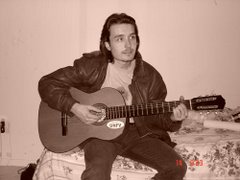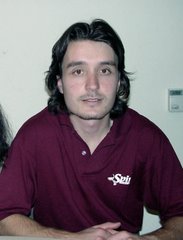
Avalon again 2005

Avalon again 2005
Spirits

Tuesday, May 8, 2007

MY CV

Curriculum Vitae
Valentin Tassev
tel. (011) 477-7838; cell: 0820530119;
E-mail:
tassevi@abv.bg

Career Objective: To pursue a career in the field of diplomacy and international relations or any journalism or publishing-related field.

Education: University of the Witwatersrand, Johannesburg (2006-2007)-Master of Arts in International Relations.

University of the Witwatersrand, Johannesburg (2005)
Bachelor of Arts with Honours (International Relations).

University of the Witwatersrand, Johannesburg (2004)
Bachelor of Arts.
Majors: International Relations, Media Studies, French Studies, Italian Studies.

Special Achievements (Awards):
2002-awarded life-time membership in Golden Key Honour International
Society for being among the top fifteen percent students in 2001.
2002-prize-giving award by the Italian-South African society for being the best student in Italian studies in 2001.

Employment history:
TOP CD
, Cresta
Tasks and Responsibilities:
-customer assistant; cashier; floor manager.

Brazilian Coffee Shop, Westgate
Tasks and Responsibilities:
waiter; cashier, departmental manager.

UJ New Arts Centre:
Tasks and Responsibilities:
lighting and sound design; technical crew; stage preparation.

Skills:
-team leadership; attaining objectives through team-work processes;
-inter-personal skills; presentation skills; communicative skills; oral skills
-management skills; customer-minded skills.

Social activities, hobbies and interests:
Sport: Football, Cricket, Tennis and Volleyball. I think that participation in
sports develops various skills, such as conflict management, team
leadership, discipline, commitment, character and physical health.

Membership in Social Anthropology Society at Wits.
Membership in Italian Society club at Wits.
I believe that these activities teach one to be hard-working,
disciplined, organized and always strive at the best.

Referees: Ms Natalie Zahringer
Senior lecturer in the School of Social Sciences; Department of
International Relations, University of the Witwatersrand; tel.: (011) 717-4393.

Mr Brett Coetzee
TOP CD Cresta Manager; tel.: (011) 476-7414.

Monday, May 7, 2007

How to be a "Presenter"?

Today’s session by Des Patel was an insightful introduction into the question of presentation skills. By asking us to do various exercises, she helped us understand that developing presentation skills is just a matter of practice and anybody could develop such skills.
In particular, she highlighted a number of key areas that each one of should work on when doing our presentations-for example, building confidence, speaking loud, projecting your voice, body language, the way you stand etc. In general, I believe that today’s session was an extremely valuable lesson and a good practice for our oral presentations on Friday, the eleventh of May.

Friday, May 4, 2007

"You and I"

Today’s presentation by Roy Blumenthal was one of the most exciting experiences of the world of work training programme so far. In fact, his presentation helped me understand that at the work-place and in life, in general, individuality and your own personal identity are the most effective means by which you project and expose yourself.
In fact, when I came to South Africa in August 2000, I thought that the only way for me to integrate successfully into the South African society was to abandon my values, habits and principles that I acquired in Bulgaria. Believe it or not, this was a wrong strategy and in fact, people in South Africa liked me for who I was-at times a little bit naughty, crazy and too wild. Later on, I understood that your identity and your personality are unique and you should not be ashamed of it. At the end of the day, people like you for who you are and not for whom you are pretending to be.
In this regard, Roy’s session helped me understand once again that we should be proud of our own identity and uniqueness, and not feel ashamed to express it in any given situation. As he stated, all of us are unique and all of us will be remembered in one way or another. Thanks, Roy, thank you, guys!
I would like just to add something to that. As much as people should strive to preserve their roots and identity, they should also try to learn from each other and be keen on opening to other peoples’ cultures and backgrounds. Again, my experience in South Africa taught me that one should try and understand other peoples’ cultures and environments, and assess the historical conditions from which all social relationships have emerged from (in this particular country). Tolerance and mutual understanding are required for one to understand other people and yet this effort helps you also learn new things and develop yourself in different directions. In my own case, South Africa contributed to my intellectual and spiritual development and I am grateful to anybody who took participation into this.

Wednesday, May 2, 2007

What does it really mean? "Proudly South African"?

Dear Themba, you raise a very interesting issue-what it means to be a "proudly South African". Despite the fact that you do not elaborate a lot on that, it is interesting that one is aware of the controversial meaning of that term. I will tell you what I think very briefly.
For me, the term "South African identity" is problematic, because not everybody in this country fully understands or appreciates the vaue of the so-called "South African identity". As anyone can see, some people still live in big nice houses, some people are still left on the streets. In fact, there is no room for all these various populations of South Africa to integrate socially, culturally and even professionally. People tend to close themselves in their small social circle and identify themselves in the context of this small community that they have become part of. Even at Wits one can see a gear degree of disintegration among the students from various backgrounds. I will not go so far as to discuss the reasons for that. I think that everybody knows what they are.
However, if South Africans are looking with optimism at the World Cup in 2010 and they believe that the whole world will see that the "rainbow nation" in fact exists, they need to open to each other and show more willingness to understand the different backgrounds, cultures and ethnicities of South Africa. If not, the whole idea of the so-called "rainbow nation" will be just one utopian idea. Besides, anybody who claims that he (she) is a "proudly South African" needs to speak more than just one language, such as English. As we already know, South Africa has eleven official spoken languages. And how many people speak at least half of those? This is what we should start thinking about.
Please, Themba or anybody else, let me know if you believe that I should elaborate more on that issue!

"Conflict Resolution" and the Workplace

Berenice De la Croix's presentation on "conflict resolution" was an extremely valuable lesson for me to understand how to deal with a conflict in inter-personal relationships and at the work-place. In fact, over the long weekend, I was involved in a serious conflict with some friends of mine. In fact, the issue that we argued about was actually a minor issue, but I guess that everybody was trying to push his agenda as always and convince the others that he was right.
Honestly speaking, when arguing I am not very keen on accepting other peoples' points and ideas and I can keep on arguing for quite a long time. However, Berenice De la Croix's presentation taught me that one of the ways to deal with a conflict is to compromise or accommodate your opponent.
I remember that she mentioned that being "assertive" means that you should be both tolerant to other peoples' opinions and at the same time express your vision on a particular issue in an opened and sincere manner. Therefore, "assertiveness" does not mean that one should be a "stubborn" and neglect automatically other peoples' opinions, but listen carefully and acknowledge whenever the other person could be right in his (her) own view. Personally, this was a valuable lesson that I learnt from Berenice De la Croix's presentation and I can see that it already helps largely in inter-personal relationships as much it helps at the workplace.
Thanks, Berenice!

The Cultural Gap and the "Bulgarian Stallion"

This post aims to throw reveal the controversy around the blog name "the Bulgarian Stallion". In fact, this name was chosen with no deliberate thoughts in mind and obviously I was not aware of some connotations attached to this name. The night before I was about to choose a blog name, I watched the movie "Rocky" with Silvester Stallown, quite an old movie about a famous boxer from Philadelphia. In the movie he was referred to as the "Italian Stallion", I do not know why.
I liked this name and when I had to create a name for my blog, I decided to refer it somehow to Bulgaria. And because it had to be my own blog, I decided to name the blog "the Bulgarian Stallion". Only later I found out that this blog name had some sexual connotations attached to it, not familiar to me. For that reason I would like to say at this point that the choice for this blog name had nothing to do with any of those meanings. Obviously, I have not been aware of this meaning from a cultural point of view.
However, now that I know what it refers to, I am glad that by accident this blog name brought some movement and discussion among people. And believe it or not, I will not change it as long as it makes people think and question themselves why there is such a blog name. As Roy Blumenthal suggested, we have to be original and unique in the way we represent ourselves. Thus, with regards to the blog name, let it be!

Monday, April 30, 2007

"The Team and I"

Brad’s session was an insightful introduction into the importance of teamwork at the work-place. In fact, Brad taught us that at any given time anybody in the team could be a team leader and respectively the roles could change as the agenda of the conversation changes. As a result, anybody could given the chance to contribute to the team’s effort and it helps bring about understanding and communication among the team members.
Above all, Brad’s presentation helped me realise that teamwork is essentially about tolerance, understanding and respect among the team members. Obviously, there could be a certain degree of competition even among the team members; however, a team functions well if the members are willing to advance the interests of their collective will rather than individually.
As Brad said, team members should think in terms of “WE” and in terms if “I”, as most people tend to think!